#Worldtour: Chilean city life
Although we're often attracted by the natural beauty of the countries we visit (don't hesitate to read our article on Chile's Natural Parks), the cities can also be full of surprises, with their special atmosphere, warm welcome and interesting architecture.
Santiago de Chile: one capital, many atmospheres
With its 5.15 million inhabitants, the capital is the country's largest city, and it's immediately obvious when you arrive: districts as far as the eye can see, surrounded by impressive mountains (the Andes!).
The Plaza de Armas, the city's main square, is bustling with street artists, chess players and open-air masses.
We only visited a tiny part of this immense city: the Bellas Artes district and its Mercado Central (the city's covered market), Patronato where we wandered around and found the La Vega market, full of color, low-priced fruit and vegetables and a great atmosphere (our favorite). We also liked the Bellavista district, with its colorful houses and murals (or tags...).
We also climbed Cerro Santa Lucia (a small hill with a park) and Cerro San Cristobal, which dominates the city. When we reached the top, a 360° panorama of Santiago awaited us, and the immensity of the city struck us once again. There was also a great deal of religious activity, as a large statue of the Virgin Mary towers over the hill, and masses are held there.
>> Off to discover Chile? Discover our complete coverage from 58 chf <<
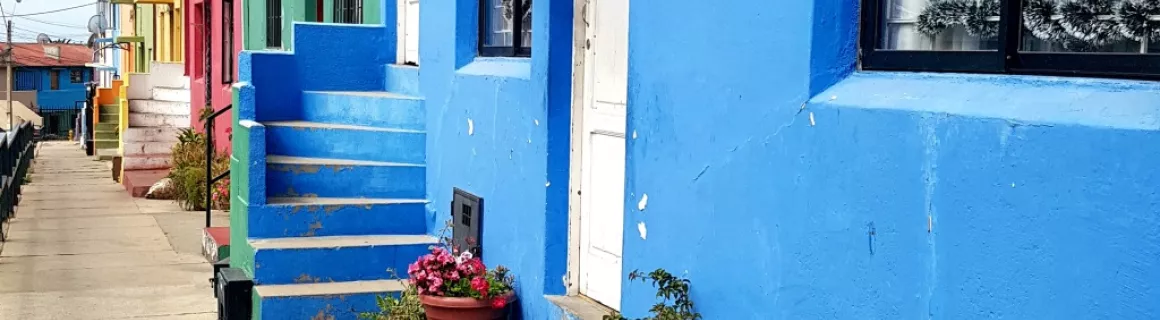
The colorful houses of Valparaíso
An hour and a half by bus from Santiago, we arrive in Chile's 2nd-largest city, known for its colorful skyline and uneven terrain.
The city is in fact on 2 levels: El Plan, the lower town, where you'll find shops, banks and general activity, and Los Cerros, the hills where the majority of people live. The higher up you go, the more you head for the working-class districts, where you shouldn't hang around too long. Despite the rich/poor divide, everyone mingles on El Plan. It's different from Santiago, where there are two distinct parts of town that don't mix.
Murals are very present in the city, mixing with graffiti and facade colors. There used to be a graffiti festival, which is no longer held, and the origin of these artistic works was initially political, when partisans painted on the walls. Today, it's illegal and artists paint at night, usually organizing themselves in groups.
We found our hostel on Cerro Concepcion, one of the most visited areas along with Alegre. Pretty, colorful streets and alleyways, music, artists exhibiting their work: all this gives us a warm and somewhat hippy atmosphere.
To reach the Cerros, take one of the 15 elevators, which are very old and very steep. Or you can go on foot and take one of the staircases, always decorated, which are generally 100 steps long. We also visited Cerro Carcel, where the city's former prison is now a landscaped park. Climbers have fun scaling the outer prison wall.
The city is very colorful, but many of the buildings are dilapidated, as in the historic center, where we walked down the 1st street that ever existed. Given that it's a Unesco World Heritage site, you'd imagine that they can't just destroy or build anything, so they leave the buildings as they are. They haven't been helped by earthquakes either, including the one in 2010 (the city market is still being rebuilt, as are some of the elevators).
Vicuña: pisco, beer and solar cooking
Vicuña is in the Coquimbo region, an 8.5-hour bus ride north from Valparaíso. We make a stop here because the area is quiet and it cuts us off from the ten-hour journey to Atacama, which we'll reach later.
We set off at 9 a.m., renting 2 mountain bikes for a circuit which, it has to be said, is not very well signposted and will take around 6 hours, counting the numerous breaks in places of interest and villages.
First stop, a distillery producing Pisco, the wine brandy we'd tasted in Santiago with the Pisco Sour cocktail. We took a tour of the vineyards, the cellar and, of course, finished with a tasting of Mango Sour and Cassis Sour. Back on our bikes, we headed for the next village, this time to a craft brewery. We were able to taste their 7 beers, which according to the expert (Olivier) were not the best in the world. Finally, the 3rd and last stop to balance out the drinking a little and eat, but not just any cuisine: solar cooking.
Apparently a typical cuisine in Vilaseca, where we went, they cook food using the sun's heat in solar ovens. Cooking takes a minimum of 2 hours, and they turn the ovens regularly, following the sun. The ovens are made of multiple mirrors, or sometimes just 4 aluminum panels and a glass pane. Our conclusion: cooking that leaves the meat tender and not at all dry.
The region is also famous for its avocados and papayas. In short, it's a paradise for eating and drinking!
Anne & Olivier
Before you leave, don't forget to take out insurance. At Europ Assistance Switzerland, we offer comprehensive coverage to protect you during your round-the-world trip. Calculate your premium for free here.
Anne & Olivier
>> Off to discover Chile? Discover our complete coverage from 58 chf <<