#Worldtour: At the end of the world in Patagonia
Puerto Madryn and the Valdés peninsula
A 19-hour drive from Buenos Aires, we reached the Province of Chubut and the ocean coast at Puerto Madryn, a small seaside resort where Argentines and Chileans come to swim in the summer.
But beyond the nautical activities, the Gulf in which the town lies is famous for its wildlife: whales, orcas, dolphins, sea lions... We're not in the season when the whales come to breed, but there are those we've come for: the Magellanic penguins.
We took a day trip to the Valdés Peninsula with a great guide who gave us lots of information about Puerto Madryn and its industries (particularly aluminium), the vegetation (which is low because it's windy and has peaks instead of leaves because of the sun: Patagonia is directly under a hole in the ozone layer), the animals, etc. The place is a World Heritage Site, and we had a great time there. The place is a UNESCO World Heritage Site, and the guide told us that this was not necessarily a good thing, because if there is a shortage of a resource in the world, if the place has that resource, it can be seized to the detriment of the local population.
Torres del Paine Park and the Perito Moreno glacier
After a short flight, we arrived in El Calafate, a base village for visiting some of Patagonia's unmissable places. It's on the edge of Lago Argentino, which is a magnificent blue and at the end of which there are a few glaciers.
Don't be fooled into thinking that we're at altitude, as we're only 200m above sea level! Patagonia offers landscapes that are normally found at over 2,000m towards home, because the area is swept by a humid wind from the Pacific and it's very cold: we were told that it snows 300 days a year above the South Ice Field, a 350 km long glacier that feeds 48 other glaciers, including the Perito Moreno (ARG), which we saw. After Antarctica and Greenland, it's the 3rd largest ice cap in the world!
>> Are you well insured for your next trip? Calculate your premium here! <<
A morning in Torres del Paine Park
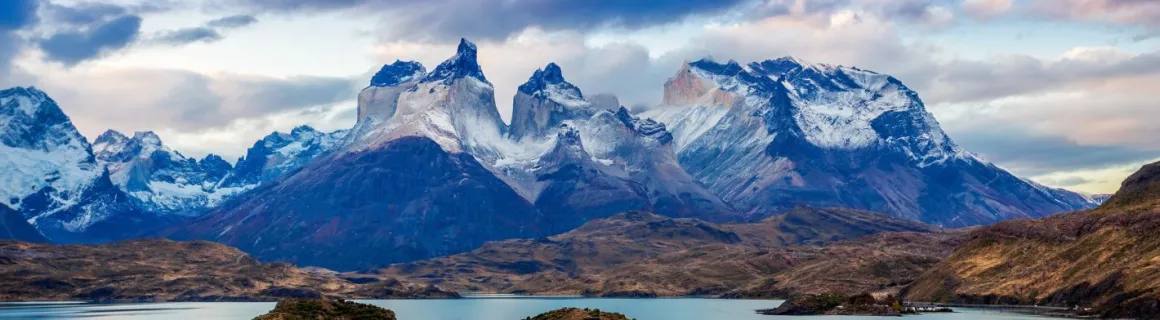
Although we were staying in Argentina, we made a brief stopover on the Chilean side to admire the magnificent Torres del Paine National Park, declared a biosphere reserve by UNESCO.
An afternoon at the Perito Moreno glacier
Located in the Los Glaciares National Park, it's the best-known glacier simply because it's the most accessible. In fact, we drove for 1 hour to reach the footbridges that allow us to admire it up close... and even very close, as this year it touched the bank on which the footbridges are located. This doesn't happen every year, and it will take some time for the end of the glacier to sink with the water, form a bridge and then collapse. The glacier is considered stable, meaning that it is not shrinking like most glaciers today. It advances by 2 metres a day in the centre but as it collapses, it keeps its size (we saw some beautiful pieces fall into the water accompanied by a loud roar).
We took the opportunity to go for a little walk on it and it was great! We put on crampons and walked along the side of the glacier (with no hidden crevasses, so it was completely safe!) in an absolutely magnificent landscape of bluish ice. To finish off, we were offered a small whisky made from around 400-year-old ice.
Chorillo del Salto and 2-day trek to Fitz Roy
A 3-hour bus ride from El Calafate took us further north into Patagonia to El Chalten, a small village in the Los Glaciares National Park where the most famous peak is Fitz Roy at 3359m.
On the first day, we took a short stroll through the village and walked to a pretty waterfall nearby. The path offered great views over the valley and wasn't too difficult.
Over the next 2 days, we hiked 47 km and spent the night in a camp at the foot of Fitz Roy. We set off early in the morning under rather grey skies to reach the Poincenot camp, a 3-hour walk away, and set up the tent. We then hiked up to the Mirador de Piedras Blancas to admire a glacier and climbed up to the Laguna de los Tres where a sublime panorama awaited us.
The next morning, we woke up early to admire the sunrise over the Fitz Roy that we could see from the camp: magical and cloudless! We then passed Laguna Madre and Laguna Hija before making our way to Laguna Cerro Torre, accompanied by impressive gusts of wind. Luckily, we were able to see the summit from a distance, because as we approached it, we were hit by a storm of wind and rain... In the middle of the afternoon, we completed the loop and returned to El Chalten. 2 days of superb scenery, alternating between forest, fields, lagoons, rocks and glaciers...
Anne & Olivier
>> Are you well insured for your next trip? Calculate your premium here! <<