#Worldtour : Getaway in Bolivia
What to see in Uyuni
Take an excursion to the Salar of Uyuni
Known as the world's largest salt desert, the Salar d'Uyuni covers an area of 10,000 km2, with salt up to 10 metres deep. During the rainy season (January-March), it is transformed into the world's largest mirror.) It was a nice surprise for us when we realised that we were in the period when the salar is flooded (only partially)!
We took an excursion that was a real eye-opener, but on the other hand, we've never felt so much like 'tourists'. You have to realise that hundreds of 4×4s leave every day at the same time, for the same tour, and you realise that the town really lives and breathes tourism. But that doesn't take anything away from the impressive scenery we saw!
Discovering the town of Uyuni
But before concentrating on discovering the desert, we spent a whole day in the town, which surprised us in a good way. It's mainly the starting point for excursions and you rarely hear about the town itself, so we're going to correct that!
What we really appreciated was the liveliness of the city from morning to night, thanks to the many street vendors who sell everything, including more elaborate dishes than we used to eat in the Chilean streets. There's a lot of pork, chicken, potatoes, rice and the main thing is that it's fried. They serve the food on mini plates, which we then return to them, and we eat with the other 'customers' in the street on plastic chairs or benches.
Still on the subject of food, we visited the city's covered market, which was super fun with lots of colours and almost exclusively locals.
As well as the food, there's plenty of colour thanks to the women dressed in typical clothes, some of the buildings and the shops selling handicrafts (the same as in Chile, still in the Andean spirit).
>> Insure your next trip to Bolivia from CHF 46 <<
What to do in La Paz, the world's highest capital (alt. 3,640m)?
We spent 1 and a half days in La Paz, which we'd heard great things about even though it wasn't really in our plans. We're glad we did, because the city is really impressive and the historic centre is really nice.
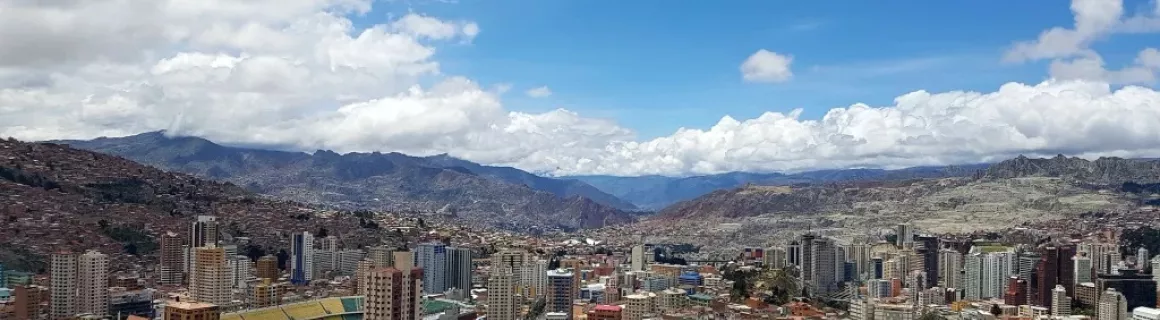
La Paz, the administrative capital of Bolivia (Sucre is the constitutional capital) and its million inhabitants surprised us above all by its geography. Santiago already seemed huge, with an atypical relief, but this was something else again! We wandered around the historic district where we were staying: San Francisco church, the Witches' Market with its shops hanging llama foetuses (in Aymarane culture, they bring good luck), pretty cobbled streets, the weekend market that stretches over several streets (you can spend hours there) or Plaza Murillo with its big church and the Government Palace. All this while constantly going up and down, Lausanne to the power of 10.
As we love walking, we climbed up to the Mirador Kili Kili overlooking the city, and it was well worth the effort! We arrived to an impressive view and it blew us away (although we're not big fans of big cities). The geography of La Paz is incredible, and even the mountains don't stop the houses from going up very high.
We also tried out 2 of the city's 3 cable cars: once to go to the cemetery, which is original, huge and full of flowers, with lots of people going there, and another time to go down from El Alto to the city centre. A superb view from the cabin! They want to build more and make the biggest network in the world.
A side trip to discover Tiwanaku, the city of the sun
An hour and a half by bus from La Paz, we went to visit the ruins of Tiwanaku (Tihuanaco), a much older civilisation than the Incas and one that dominated for much longer (Tiwanaku: 5th BC - 12th AD and Incas 15th - 16th AD).
The Tiwanaku mainly inhabited the southern part of the Andes (Chile and Bolivia) and their civilisation originated near Lake Titicaca, which is just a few kilometres from the archaeological site.
We were able to admire the Akapana Pyramid, the semi-subterranean temple and the Kalasasaya temple with its Sun Gate (engravings representing a calendar, the gate aligned according to the equinoxes and solstices). All these buildings were used for ceremonies to celebrate the god Viracocha.
We also visited the adjoining museum, where they have exhibited the Benett monolith (a 7-metre-high statue that originally stood in the middle of the Temple of Kalasasaya) and it's very impressive! They had originally put it on display in a square in La Paz before realising that it was damaging it... It was then returned to its place of origin, thanks mainly to the fact that the site is a UNESCO World Heritage Site.
Anne & Olivier