Tolls in France: tips and tricks for motorists
What you need to remember
- Plan your trips ahead: unlike the swiss motorway vignette, french motorways are charged by distance.
- Prepare your payment methods: prefer a credit card (visa/mastercard) and cash in euros.
- Beware of debit cards (maestro/postcard), which are often refused.
- Save time: the electronic toll badge (available for swiss residents) helps avoid queues.
- “Free flow” is becoming widespread: on some routes (a79, a13/a14), barriers are disappearing. Payment must be made online after passing.
- In case of breakdown on the motorway: stop safely, call via an orange emergency phone. Only an authorized tow truck can intervene. europ assistance takes over after leaving the toll to organize the next steps.
Every year, thousands of Swiss drivers head to southern France, the Atlantic coast or Paris. Sunshine, varied landscapes… and tolls! Between toll gates, queues and electronic badges, it’s easy to get confused — or waste time.
Used to the simple Swiss motorway vignette system, Swiss drivers may be surprised by the complexity and cost of French motorways. Before crossing the border, it’s best to understand how tolls work, which payment methods to use (and which to avoid!), and how to react in case of a breakdown.
This practical guide brings together everything you need to know for a stress-free trip: the right habits at tolls, tools to calculate your budget in Euros, and Europ Assistance tips to avoid unexpected issues on the road.
How do tolls work in France?
In France, most motorways are tolled based on the user-pays principle: you pay according to the distance traveled. At the motorway entrance, you take a ticket; at the exit, you present it so the amount due can be calculated. This system applies to most of the network managed by concession companies (AREA, APRR, Vinci, Sanef…).
The different types of tolls
Tip: The fastest lanes are often on the left side of the toll, but they are usually reserved for electronic toll badges. If you don’t have a badge, pay attention to the signs.
Classic toll
This is the most common: a barrier with booths where you pay in cash (Euros), by card or with a badge. Waiting times can be long during peak travel periods, especially on July and August weekends.
Electronic toll (Liber-t / Bip&Go / Ulys)
Thanks to a small device attached to the windshield, passage is automatic: the barrier lifts as soon as you reach the gate (sometimes at 30 km/h without stopping). The amount is debited later from your bank account or credit card. The badge can be subscribed from Switzerland and often works in Spain, Portugal and Italy too.
“Free Flow” Toll
Increasingly common (notably on the A79 in Allier or the A13/A14 in Normandy), this system no longer has barriers. Gates equipped with cameras identify your vehicle by its Swiss license plate.
Attention: Payment is not made at a roadside booth! You must do it yourself online or at a rest area terminal, usually within 72 hours.
The different payment methods
Several payment methods are accepted, but as a Swiss resident, some banking specifics should be anticipated to avoid being blocked at the barrier.
1.Pay in cash
This is the simplest method if you don’t have the right card. You can pay at a staffed booth (rare) or via an automatic basket.
Drawback: You must have Euros with you (Swiss Francs are not accepted). Moreover, these lanes are often the most congested.
2.Pay by Bank Card
Lanes marked “CB” allow quick payment.
Beware of Swiss cards: French toll machines almost always accept credit cards (Visa, Mastercard, American Express). However, debit cards (Maestro, V Pay) and especially PostCard are very often refused.
Tip: Always travel with a valid credit card or cash in Euros.
3.Use an electronic toll badge
The badge is a small device attached to the windshield. Payment is automatic and debited monthly.
Subscription: There are “pay-as-you-go” options (ideal for holidays) where you only pay management fees (around €1.70) in the months you use the badge.
Availability: Most providers (Bip&Go, Ulys, Fulli) deliver badges to Switzerland.
Good to Know: It’s the only way to access the fast “30 km/h” lanes and avoid queues at barriers.
4.“Free Flow” Tolls
If you use a section without barriers (indicated by “Péage Flux Libre” signs), gates detect your license plate.
Payment: You must log on to the operator’s website (e.g., aliae.com or autoroutes.fr) within 72 hours to pay the amount.
Risk: If you forget, the fine will be sent to your home in Switzerland.
5.Quick comparison
| Payment method | Main advantage | Limitation / drawback (for Switzerland) |
| Cash (Euros) | Accessible to everyone, no bank fees. | Long queues in summer. Requires withdrawing Euros before departure. |
| Credit card | Fast, automatic, dedicated lanes. | Attention: PostCard and often Maestro cards do not work. |
| Electronic toll | Maximum time saving, no stop. | Requires a subscription (deliverable in Switzerland). |
| Free flow | 100% smooth, no stop. | High risk of forgetting. Payment mandatory online within 72 hours. |
Europ Assistance tip: If you travel regularly in France or to southern Europe, the electronic toll badge is the smoothest option. Otherwise, make sure you have an active credit card.
Which toll gate should you choose?
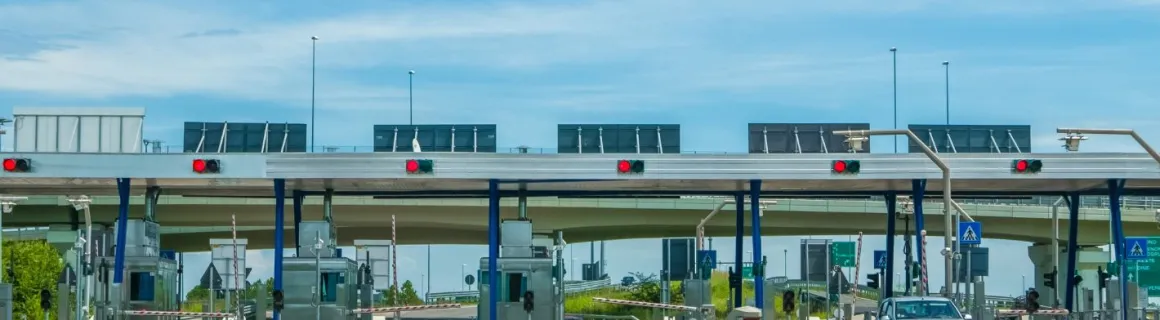
Face à la file de portiques, on hésite souvent : lequel prendre pour éviter d’attendre ou de se tromper ?
Chaque voie est signalée par un symbole lumineux : bien les repérer vous fera gagner du temps… et un peu de sérénité.
Pour un aperçu complet des panneaux, consultez la page officielle : Signalisation des péages sur autoroutes.fr
Astuce : Si vous êtes sans badge, évitez les voies tout à gauche (souvent marquées d'un "t" orange) : elles sont réservées au télépéage. Restez plutôt au centre ou à droite, où se trouvent les voies mixtes (Flèche verte ou symbole "Cartes").
Faced with a row of toll gates, you often hesitate: which one to take to avoid waiting or making a mistake?
Each lane is marked by a light symbol: spotting them correctly will save you time… and a little peace of mind.
For a complete overview of the signs, check the official page: Toll signage on autoroutes.fr
Tip: If you don’t have a badge, avoid the lanes on the far left (often marked with an orange “t”): they are reserved for electronic toll. Stay rather in the center or on the right, where you’ll find mixed lanes (green arrow or “Cards” symbol).
And if you choose the wrong gate?
Never reverse, even if you see an empty lane next to you. This maneuver is strictly prohibited and dangerous.
Simply press the call button (intercom): an operator will intervene remotely and can either open the gate or process your payment manually.
Prepare to avoid queues and accidents
Always keep your payment methods within easy reach before arriving at the gate. Avoid rummaging through your wallet or bag while in line: it’s dangerous and causes the slowdowns everyone dreads.
How to calculate the price of a trip?
Before leaving, we recommend estimating the total cost in Euros. Unlike the Swiss vignette at 40 CHF, a round trip Geneva-Montpellier or Basel-Paris can be expensive.
Online tools to know the price:
- ViaMichelin: Allows you to get the full cost (fuel + tolls) based on your vehicle.
- Autoroutes.fr: The official site for an accurate fare simulator.
- GPS apps: Waze or Google Maps estimate costs, but beware of data consumption (roaming) if your Swiss plan doesn’t include it!
Breakdown or incident on the motorway: what to do?
A flat tire, engine failure or a red warning light… These situations are stressful, especially abroad. It is crucial to know the French procedure, which may differ from Switzerland.
1. Immediately secure the area
Park on the emergency lane, put on your fluorescent vest, exit on the right and stand behind the safety barrier. Never stay inside the vehicle.
2. Alert The Emergency Services (Not Your Insurer Right Away!)
On French motorways, only motorway companies can send a tow truck. Assistance providers are not allowed to send their own tow trucks onto the motorway.
- Use an emergency call box (orange, every 2 km).
- Or call 112.
- Or use the SOS Autoroutes app.
Tips for swiss motorists
Driving in France from Switzerland is a summer ritual. But a few simple tips can save you a lot of trouble.
1. Prepare your payment methods
Make sure you take a credit card (and not just a Maestro/PostCard). Always keep some Euro bills for small tolls or in case of terminal failure.
2. Avoid peak hours
The crossover Saturdays are dreaded, especially in summer (“Black Saturday”). Check the French Bison Futé calendar or our traffic jam forecast calendar for the summer. Leaving on Sunday or driving at night is often a winning strategy to avoid traffic at the Gotthard tunnel… and at French tolls!
3. Watch speed limits
- 130 km/h on motorways (110 km/h in rain), not 120 km/h like in Switzerland.
- Attention: Some sections near big cities (like Lyon or Paris) temporarily drop to 90 or 70 km/h in case of pollution.
- Speed cameras: They are numerous and do not always flash from the front. Thanks to bilateral agreements, fines arrive directly in your mailbox in Switzerland.
4. Check your assistance coverage
Before leaving, check your travel insurance.
Make sure it covers, among other things:
- Medical expenses (LAMal only covers emergencies and often limited abroad, but in France, extra fees also exist)
- Emergency transport
- Medical repatriation
5. Keep good digital habits (Beware of roaming)
France is part of the EU, but Switzerland is not.
- Mobile data: Check if your Swiss mobile plan includes “Data” in Europe. Otherwise, the bill can be very steep if you use Waze or Spotify throughout the trip.
- Tip: Download Google Maps in “offline” mode before leaving your home Wi-Fi.
- Europ Assistance Advice: Anticipate the unexpected, but don’t stress. A serviced vehicle, a valid payment method and good assistance make up 90% of a smooth trip
Travel with peace of mind with Europ Assistance
Our travel services at a glance:
- 24/7 assistance in case of emergency in Switzerland and abroad
- Coverage of medical expenses abroad
- Insurance in case of trip cancellation or interruption
- Exclusive services: Dogs & Cats extension, concierge service
>> Calculate your premium for free here <<
Frequently asked questions about tolls in France
Can you use a Swiss bank card at tolls?
Yes for credit cards (Visa, Mastercard). No for most debit cards (PostCard, Maestro, V Pay) at automatic machines. Plan ahead!
Is the electronic toll badge worth it for a single trip?
Yes, with the “à la carte” option. You don’t pay a fixed monthly subscription for the year, only about €1.70 for the month you use it. To avoid 45 minutes of waiting under the sun, it’s a minimal investment.
What should I do if I forget to pay a free-flow toll?
Go to the motorway company’s website (e.g., autoroutes.fr) within 72 hours. After this period, you will receive an increased fine at your Swiss home address.