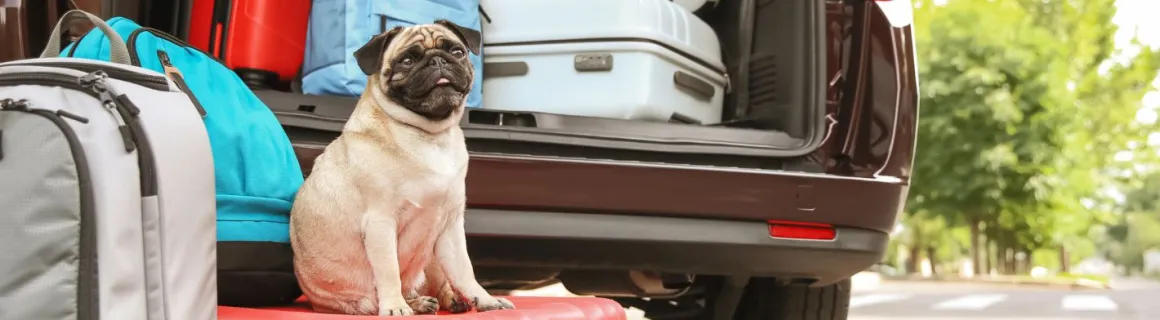
Holidays with a dog: for a successful trip
Travel peacefully with your four-legged companion
Spending the best days of the year with your pet is a wish shared by many dog owners. To make holidays with your dog an unforgettable experience for everyone, good preparation is essential.
However, several points need to be considered: from choosing the destination to travelling safely, including the country’s entry requirements. This guide walks you through the planning process step by step and offers valuable tips to help you set off well prepared with your dog.
Key points at a glance
- Accommodation choice: Book dog-friendly hotels, holiday homes or campsites that offer specific services and enough space for your companion.
- Important preparations: Consider entry requirements for dogs, especially the pet passport. Also check local regulations such as leash or muzzle requirements.
- Packing list: Essentials include food, water bowl, leash, toys, medication and travel documents. With our checklist, your holiday will be stress-free.
- Travel and stay: Get your dog used to your mode of transport in advance. Bring familiar items to help them adapt more easily once there.
Planning holidays with a dog: destinations, rules and preparations
Every good preparation starts with a few basic questions: is this trip suitable for my dog, and which destinations are possible?
We guide you through all the key steps so you don’t forget anything and are perfectly prepared.
Is my dog fit to travel?
Before booking, ask yourself whether travelling is suitable for your dog. Consider their age, health condition and temperament.
An active dog will enjoy a hiking holiday in the Alps or a beach stay with plenty of exercise.
An older or calmer dog will feel better in a quiet holiday apartment with short walks. The type of transport is also important: some dogs prefer the car to the train or plane.
An elderly, sick or very anxious dog won’t enjoy a long journey and unfamiliar surroundings.
Puppies that are not yet house-trained or whose vaccinations are incomplete should stay at home. If in doubt, consult your vet before travelling.
>>Going on holiday? Calculate your COMFORT insurance premium, which includes the Pets extension <<
Dog-friendly European destinations
Many European countries are very welcoming to dogs. Here are some ideal destinations:
- Germany: Being relatively close to Switzerland, it involves a short journey, which is often key to a stress-free start to the holidays. Germany is therefore a great idea. The Baltic Sea offers many dog beaches where dogs can often run off-leash, such as in Kühlungsborn or Grömitz. On the North Sea, the car-free island of Juist specialises in welcoming dogs, with dedicated beaches and many suitable accommodations. Even far from the coasts – from the Harz to the Bavarian Alps – the infrastructure is excellent for holidays with your dog.
- Austria: A true paradise for active holidaymakers with dogs. Whether in Tyrol, Carinthia or the Salzburg region, Austrians are known for their dog-friendly attitude. Numerous hiking trails, cycling paths like the Danube route, and mountain lakes offer pure nature – ideal for sporty holidays. Note: in public transport and on many cable cars, muzzles are mandatory.
- Denmark: A classic for holidays with dogs. Wide, endless beaches and a large selection of dog-friendly holiday homes make the country ideal for long walks and relaxed vacations.
- Netherlands: Like Denmark, the Dutch coast offers plenty of space for dogs. In the low season, they can often run freely on the beaches. The island of Texel is particularly dog-friendly. The Netherlands also offers many suitable parks and forests, as well as restaurants and cafés where dogs are welcome.
- France: The French are known for their relaxed attitude towards dogs, which are often accepted in restaurants. Regions like Brittany and Normandy are ideal for peaceful holidays. On the coasts, there are dog-friendly beaches (marked “plages autorisées aux chiens”), for example on the Côte d’Armor. Even Paris, with its hundreds of parks and suitable hotels, is very welcoming. Caution: certain dog breeds (categories 1 and 2, such as pit bulls, boerboels, tosas, rottweilers and their crosses) are banned from entry.
- Sweden: A leader in Scandinavia, Sweden offers a wide selection of dog-friendly holiday homes. What makes Sweden unique is the “Allemansrätt” (right of public access to nature) enshrined in the Constitution: it allows camping almost anywhere in nature – perfect for hikes or canoe trips with your dog. Note for entry: in addition to European rules, you must declare your dog to Swedish customs, which can easily be done online in advance.
Finding the right accommodation: hotel, holiday home or campsite?
Choosing the right accommodation is essential to ensure well-being during your holiday with your dog.
Each option has its advantages:
- Dog-friendly hotels: Ideal for short stays and travellers who appreciate services. Check whether dogs are simply “tolerated” or truly “welcome” – extras like a bowl or bed in the room are good indicators. Always inquire about additional fees (overnight charges, end-of-stay cleaning) and the availability of a fridge to store food.
- Holiday homes and apartments: Offer maximum freedom and space. A private kitchen is perfect for preparing meals, and a fenced garden allows your dog to play safely. Again, it’s important to clarify any extra fees in advance.
- Campsites: Perfect for nature-loving and flexible holidaymakers. Check in advance whether dogs are allowed and whether there are specific facilities such as dog areas or showers. Also familiarise yourself with the site’s rules (e.g. leash requirements).
- Special case: cruises: Some companies offer special cruises for dogs. The rules are very specific, so it’s essential to get detailed information from the company.
Our tip: Whatever your choice, always contact the provider before booking. A simple call can clarify open questions and avoid unpleasant surprises upon arrival.
>>Going on holiday? Calculate your COMFORT insurance premium, which includes the Pets extension <<
Entry requirements for travelling in the EU with a dog
Travelling with a dog within the European Union is subject to clear and uniform rules. Compliance is essential to avoid problems at borders or even quarantine.
Here’s what you absolutely must have and follow:
- Pet passport: This document is your dog’s “passport”. It is issued by a veterinarian and contains all important information about the animal, including identification number and vaccinations.
- Microchip identification: For clear identification, your dog must be equipped with a microchip compliant with ISO 11784. Tattoos are only accepted if they were done before July 3, 2011 and are clearly legible.
- Valid rabies vaccination: Your dog must be vaccinated against rabies, and this vaccination must be recorded in the passport. Important: the first vaccination must have been administered at least 21 days before crossing the border to be considered valid.
- Treatment against worms (Echinococcus multilocularis): Some EU countries, such as Finland, Norway and Malta, require worm treatment before entry. This treatment must be carried out by a veterinarian shortly before departure and documented.
- Attention to puppies: According to EU rules, puppies can only cross borders from 15 weeks of age. This corresponds to the minimum age for the first vaccination (12 weeks) plus the 21 days required for the protection to be effective.
- You can find more information on the website of the Federal Food Safety and Veterinary Office.
Travelling to non-EU countries: specific rules
For travel outside the EU, the rules are often stricter. Always check in advance with the embassy of the destination country.
For many neighbouring countries such as Norway, the passport is generally sufficient. For the United Kingdom and Northern Ireland, worm treatment is also mandatory.
Attention when returning to Switzerland:
To return from high-risk or uncertain rabies countries (e.g. Turkey, Morocco, Serbia, Egypt, Thailand), a rabies antibody test is mandatory.
For low-risk countries such as the United States, Canada or the United Kingdom, this test is not required.
Note: entry into Switzerland is only permitted via officially authorised entry points, and when travelling by direct flight, it is allowed via the airports of Basel, Geneva or Zurich.
Health preparation
Health preparation is the most important step in planning and a requirement for meeting entry rules.
- Visit to the vet: Consult your veterinarian well in advance of departure. They will check your dog’s general condition, vaccination status and advise you on a possible first-aid kit.
- Protection against travel-related diseases: For trips to the Mediterranean (Italy, Croatia, Spain, France, Greece), prevention against specific diseases is essential. This includes:
Leishmaniasis (transmitted by sandflies)
Babesiosis or “dog malaria” (transmitted by ticks)
Your vet will advise you on the best protection, such as spot-on pipettes or antiparasitic collars.
All set? The ultimate checklist for holidays with your dog
Just before departure, it’s time to take care of the final practical steps.
Create an emergency plan: Find out in advance the address and phone number of a veterinary clinic near your holiday location. This will give you peace of mind in case of unexpected events.
Good preparation also helps avoid stress. With our checklist, you can be sure not to forget anything essential in your luggage.
Food and water
- Enough food for the entire stay
- Food bowl and water bowl
- Water bottle for outings
Leash, harness, muzzle
- Sturdy leash
- Safety harness or collar
- Muzzle (mandatory in many countries and on public transport!)
- Spare leash or collar
Toys and entertainment
- Your dog’s favourite toy
- Chew bones or chew sticks for relaxation
- Treats
Rest and sleep
- Blanket or cushion for a familiar sleeping spot
- Portable dog bed
Hygiene
- Plenty of waste bags for the entire stay
- Dog shampoo and brush
- Tick repellent and flea prevention
- Towel for wet or dirty paws
- Dog first-aid kit: bandages, disinfectant, tick remover, paw balm
- Any regular medication your dog takes
- Emergency number and address of the local vet
Trackers and tags
- GPS tracker to locate your dog in case of emergency
- Holiday tag with your accommodation address and phone number
- Standard tag with your contact details
Travel documents and permits
- European pet passport with up-to-date vaccinations
- Copy of dog liability insurance
- Travel documents and accommodation booking confirmation
If needed:
- Life jacket
- Cooling vest or mat for hot destinations
- Paw protection (for rocky or hot surfaces)
Travel – setting off safely with your dog
The journey is often the most stressful part for the dog. But with good preparation, you can approach this first step with peace of mind.
The choice of transport depends on the destination, the duration of the trip, and your dog’s temperament.
Whatever mode of transport you choose, safety is always the top priority.
>>Going on holiday? Calculate your COMFORT insurance premium, which includes the Pets extension <<
Travelling by car with your dog
Travelling by car offers great flexibility. Here are the key points to keep in mind:
- Safety is mandatory: An unsecured dog is considered an improperly secured load. Use an approved transport crate in the boot or a safety harness with a seatbelt on the back seat.
- In summer: Avoid the hottest hours and travel early in the morning or in the evening. During peak heat, take breaks in the shade.
- Offer water regularly: Bring a large bottle of water and a travel bowl to hydrate your dog at every stop.
- Plan breaks: Every two hours, take a break so your dog can drink and stretch its legs.
- Golden rule: Never leave your dog alone in a parked car, even for “5 minutes”. The interior temperature can quickly become deadly.
- Beware of drafts: They can cause conjunctivitis. Also protect your dog from direct sunlight with a sunshade on the window.
Travelling by train with your companion
On SBB trains, small dogs (up to the size of a cat) travel free in a carrier. Larger dogs must have their own ticket (2nd class half-fare or minimum transport fare), be kept on a leash and wear a muzzle.
For more information, visit the SBB website.
Tips for the journey:
- Avoid peak hours (morning and late afternoon).
- If possible, book a seat in a compartment, which is quieter than open carriages.
- Before departure: A long walk will help your dog burn off energy and better cope with waiting and travel.
Flying with your dog: what you need to know
Air travel is often stressful for dogs. It should only be considered if absolutely necessary. If you yourself are anxious when flying, your dog may sense that tension.
Important to know:
- Not all airlines accept animals. Always check before booking.
- Conditions for cabin transport (for small dogs) or cargo hold vary by airline.
- The number of animals per flight is limited: register your dog in advance to secure a spot.
- General guidelines are available from IATA (International Air Transport Association).
Arrival and stay – helping your dog feel comfortable
You’ve finally arrived! Now it’s important that your dog adapts quickly and enjoys the stay.
Settling in at your holiday destination
Let your dog explore the surroundings at their own pace. Show them around your accommodation and set up a space with their blanket and toys. This provides security and familiar cues.
Stick to your usual schedule for meals and walks. A long walk right after arrival helps process first impressions.
Local rules and etiquette
Respectful behaviour is essential for a peaceful holiday. Check local regulations regarding leashes and muzzles, which are often mandatory on beaches, in parks, restaurants and public transport.
Example: In Italy, muzzles are mandatory and leashes must not exceed 1.5 metres.
Make sure your dog doesn’t disturb other holidaymakers and always clean up after them.
Tip for families with children and dogs: Teach children to respect the dog and interact properly. Also ensure the dog has quiet moments to rest undisturbed.
Activities to enjoy during your holiday with your dog
Explore nature with your dog: mountain hikes, beach walks… If your dog loves water, check for dog-friendly beaches or lakes near your accommodation.
Tip: See if there’s a dog park at your destination. Your dog can run freely and you might meet other dog owners.
Your shared adventure can begin!
You’ve thought of everything: the ideal destination is chosen, dog-friendly accommodation is booked, and thanks to our tips, you’re perfectly prepared for the journey.
To fully enjoy this precious time with peace of mind, one last important step completes perfect planning: protection in case of unforeseen events.
What happens if your dog or you fall ill just before departure and have to cancel the trip?
With our COMFORT travel insurance and its Dogs & Cats extension, your pet is considered a close family member: if they fall ill or have an accident that prevents you from travelling, you’re covered in case of cancellation.